
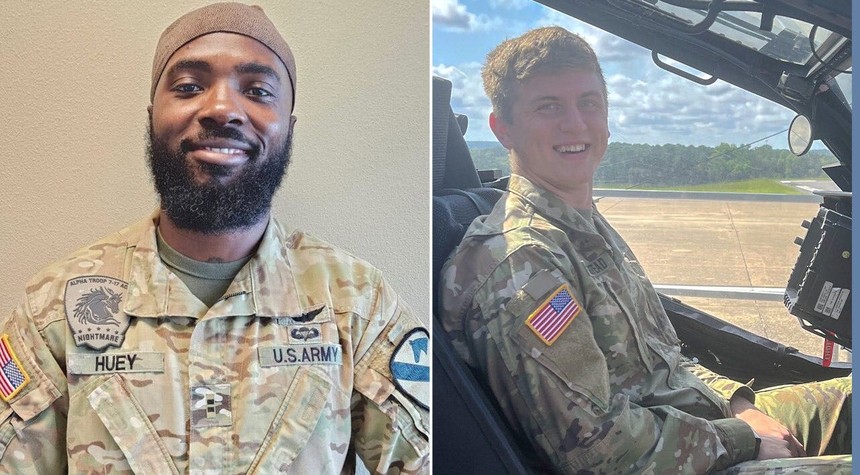
Two Army aviators lost their lives Wednesday when their AH-64E Apache helicopter crashed during a routine training exercise near Salado, Texas, prompting evacuations and igniting a wildfire in the surrounding area.
Fort Hood officials identified the fallen soldiers Friday as Chief Warrant Officer 2 Deontre T. Huey and Warrant Officer Seth L. Olmstead. Both men were conducting standard flight operations when the incident occurred south of the central Texas community.
“Our hearts and deepest condolences are with the families of the Soldiers we lost Wednesday,” stated Lt. Gen. Kevin D. Admiral, commanding general of III Armored Corps and Fort Hood. “The Army is a family, and a tragedy like this is felt throughout our formations and our community.”
The crash sparked a wildfire that required local authorities to order evacuations in the immediate vicinity. Fire crews worked to contain the blaze while military and civilian investigators secured the crash site. The cause of the accident remains under investigation, with Army officials indicating a full inquiry is underway to determine what led to the helicopter’s catastrophic failure.
Chief Warrant Officer 2 Huey entered military service as a motor transport operator before transitioning to aviation. Warrant Officer Olmstead’s service record was not immediately detailed in the Army’s statement, though both men had completed the rigorous training required to pilot one of the military’s most sophisticated attack helicopters.
The AH-64E Apache represents the latest variant of the Army’s primary attack helicopter platform, featuring advanced targeting systems and upgraded engines. These aircraft regularly conduct training exercises to maintain pilot proficiency and unit readiness.
This incident marks another somber reminder of the inherent risks service members face, even during peacetime training operations. Military aviation, while substantially safer than in previous decades due to technological improvements and enhanced safety protocols, continues to demand the highest levels of skill and carries unavoidable dangers.
Fort Hood, one of the Army’s largest installations, houses multiple aviation units and serves as a major training center for armored and aviation forces. The base has experienced its share of tragedy over the years, making this latest loss particularly poignant for the military community there.
The Army has not released additional details regarding the specific nature of the training exercise or whether other aircraft were involved in the operation. Standard protocol following such incidents involves a comprehensive safety investigation that examines mechanical systems, weather conditions, and operational procedures.
As investigators work to determine the cause of this tragic accident, the focus remains on supporting the families of these two fallen aviators who made the ultimate sacrifice while serving their country. The loss serves as a stark reminder that military service involves risk at all times, whether in combat zones or during the essential training that keeps our forces ready to defend the nation.
Related: Ohio Haitians Receive Electronic Monitoring as Detention Facilities Reach Capacity
