
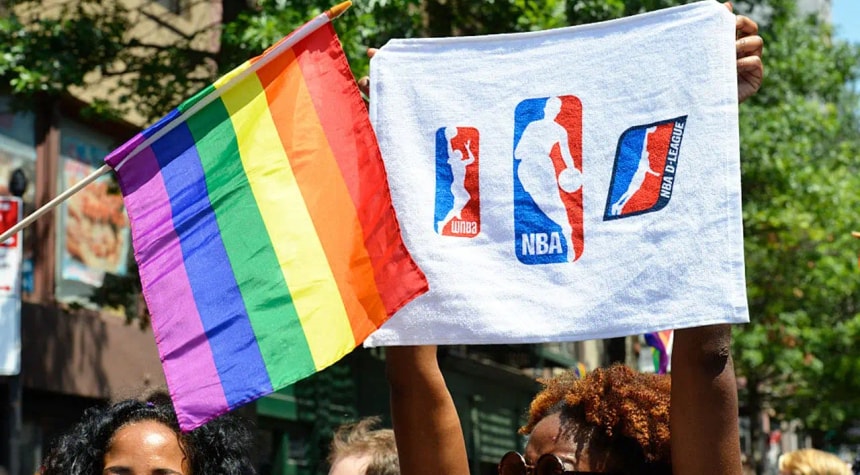
The national anthem singer who waved a Pride flag during his performance before Thursday’s Golden State Warriors game has responded to widespread criticism, and his explanation has done little to quell the controversy.
Jason Brock was selected to perform the pregame national anthem during the Warriors’ Pride Night celebration for their home game against the Miami Heat. As he reached the lyrics "What so proudly we hailed," Brock produced a small Pride flag and began waving it while nodding his head. The crowd’s reaction appeared tepid at best, and television cameras captured several Warriors players appearing to laugh during the performance.
The incident has reignited a familiar debate about proper decorum during the national anthem. What should be a straightforward moment of national unity has once again become complicated by political and social messaging.
Brock took to social media to address speculation that the players were laughing at his flag display. "Wow I didn’t interpret it like this, but I wasn’t watching the players," he wrote. "Just because they were laughing doesn’t mean it was because of the anthem." Whether the players found his performance amusing or were laughing for unrelated reasons remains unclear. However, that question misses the larger point entirely.
The controversy arrives just weeks after similar incidents during the Women’s National Basketball Association Finals, where anthem protests and perceived disrespect generated significant public discussion. The pattern suggests an ongoing struggle within professional sports to maintain traditional standards of respect during national ceremonies.
The request from critics is straightforward. The national anthem represents a brief moment, typically lasting less than two minutes, dedicated to honoring the nation and the principles for which it stands. It is a ceremony that has remained largely unchanged for generations, serving as common ground in an increasingly divided society.
Those defending traditional anthem protocol argue that opportunities for personal expression and advocacy exist throughout American life. Social causes can be promoted through countless other venues and moments. The national anthem, however, has historically been reserved as neutral territory, a shared ritual transcending individual politics or social movements.
The criticism facing Brock centers not on the cause he chose to highlight, but rather on the appropriateness of the venue. The question being asked is whether every public moment must be transformed into an opportunity for advocacy, or whether certain ceremonies should remain dedicated to their original purpose.
In an era when virtually every cultural institution has become contested ground for competing visions of American society, the national anthem represents one of the few remaining moments intended to unite rather than divide. When that space becomes another platform for messaging, regardless of the message’s content or intent, something fundamental is lost.
The Warriors organization has not issued a statement regarding the performance or the subsequent controversy. The incident serves as another data point in the ongoing cultural conversation about where, when, and how Americans choose to express their values in public spaces.
Related: Two College Climbers Did Everything Right and Still Died on That Mountain
