
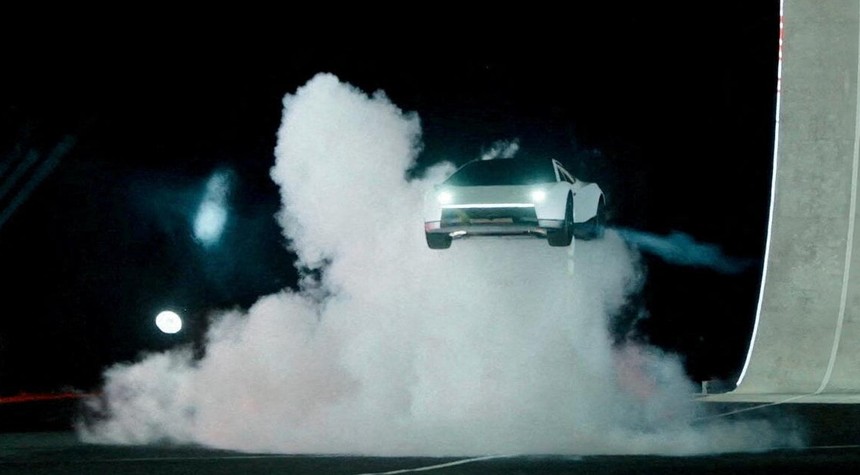
Elon Musk unveiled a prototype vehicle on Thursday that represents an ambitious fusion of automotive and aerospace engineering, demonstrating what he termed a “flying” car during a presentation at a SpaceX facility in Texas.
The Tesla Roadster, equipped with what Musk described as “ultra high-pressure air tanks,” performed a dramatic demonstration that saw the vehicle launch from a curved ramp, maintaining contact with the surface while inverted, then completing a 180-degree rotation in midair before landing on its wheels. The performance, livestreamed to viewers worldwide, showcased capabilities that have long existed in the realm of science fiction rather than practical transportation.
“Flying cars are real,” Musk stated during the event, though he tempered expectations by acknowledging that the vehicle’s “success is not guaranteed” while expressing confidence that “it will probably work.” The demonstration represented what Musk characterized as a collaboration between what he called “the world’s best car company and the world’s best rocket company.”
Tesla has announced plans to begin production of the vehicle in 2028, though pricing information was not disclosed. The company’s website currently allows prospective buyers to place reservations for a conventional, non-flying version of the Roadster with a $5,000 deposit. The flying variant, designated the Rocket model with its “full flight system,” will reportedly be available by invitation only. Tesla has made clear that the planned flying model is not approved for public road use.
The announcement raises substantial questions regarding regulatory oversight. A senior Transportation Department official expressed skepticism about the vehicle’s actual flight capabilities while acknowledging uncertainty about which agency would hold regulatory authority. The National Highway Traffic Safety Administration, which typically oversees vehicles, delegates safety certification to manufacturers. The Federal Aviation Administration has stated the vehicle does not meet its definition of an aircraft, creating a potential regulatory gap.
The concept of flying cars has captivated inventors since American aviation pioneer Glenn Curtiss debuted the first prototype in 1917. However, technical and regulatory challenges have consistently prevented such vehicles from achieving commercial viability. Recent advances in electric motors and high-performance batteries have renewed interest in the sector, though practical obstacles remain formidable.
Financial analysts view the Roadster primarily as a demonstration of engineering capability rather than a significant revenue generator. One Wall Street observer noted that production will likely be limited and should not be considered a growth driver for the company. Instead, the vehicle serves to highlight Tesla’s technical capabilities and restore what was described as the brand’s premium market positioning.
The demonstration comes at a time when Tesla faces increased competition in the electric vehicle market and scrutiny of its broader business strategy. Whether this ambitious project will transition from dramatic demonstration to practical transportation remains an open question, dependent upon both technical refinement and the resolution of complex regulatory challenges.
The path from prototype to production has proven difficult for previous flying car ventures, and Musk’s own acknowledgment of uncertainty suggests even he recognizes the substantial hurdles ahead.
Related: Measles Cases Surpass 4,400 Nationwide as Federal Health Officials Deploy to Pennsylvania
