
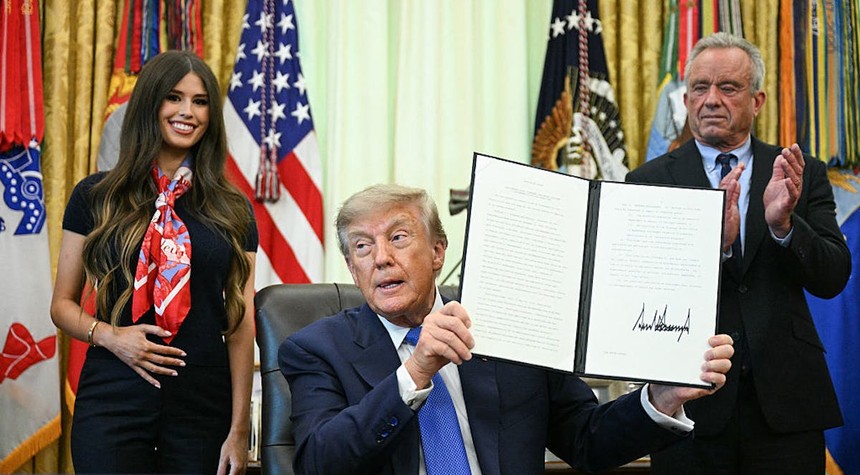
President Donald Trump signed an executive order Monday directing federal health agencies to substantially revise the nation’s childhood vaccine recommendations, marking a significant policy shift championed by Health and Human Services Secretary Robert F. Kennedy Jr.
The executive order, titled “Gold Standard Childhood Vaccine Recommendations,” instructs federal agencies to reduce the number of diseases for which vaccines are routinely recommended for all children from eighteen to eleven. The order also calls for spacing out childhood immunizations and ultimately providing the combined measles, mumps, and rubella vaccine as three separate shots.
Under the new directive, vaccines for eleven diseases—including measles, mumps, rubella, polio, and whooping cough—would remain recommended for all children. Vaccines for several other diseases, among them hepatitis A and B and meningococcal disease, would instead be recommended only for certain higher-risk groups or through shared decision-making between parents and physicians. Influenza and COVID-19 vaccines would similarly fall into the shared decision-making category.
The order further directs federal agencies to work toward making separate measles, mumps, and rubella vaccines available in the United States, where they are not currently manufactured. It calls for childhood immunizations to be administered at separate medical visits “to the maximum extent feasible.”
During an Oval Office signing ceremony, President Trump defended the changes as giving parents greater control over when their children receive immunizations. “It’s inconvenient, it’s five stops, but it’s something that I think will have a huge impact on autism,” the President said.
The President has repeatedly suggested a connection between childhood vaccines and rising autism diagnoses, though numerous large-scale scientific studies have found no association between the MMR vaccine and autism. When pressed Monday about his earlier claim that the current MMR vaccine could be “lethal,” the President acknowledged he lacked scientific evidence. “What I’ve heard is that there are some people that say it is that way, and I say, ‘Well, let’s say there’s a 5 percent chance of it; let’s split it up,'” Trump stated.
Secretary Kennedy, who has promoted vaccine skepticism for years and made reshaping federal vaccine policy a centerpiece of his tenure at HHS, stood alongside the President during the announcement. The order directs HHS to develop proposed changes to the childhood vaccine schedule within ninety days and calls for additional research into vaccine safety, alternative vaccine ingredients, and the timing and sequencing of childhood immunizations.
The practical implementation of this order remains uncertain. States, rather than the federal government, generally determine which vaccines children must receive to attend public schools. Additionally, individual measles, mumps, and rubella vaccines are not currently available in the United States. Manufacturers would need to develop and obtain regulatory approval for such products before they could be administered as separate shots.
This executive action represents a major policy victory for the Make America Healthy Again movement and signals a fundamental shift in the federal government’s approach to childhood immunization policy.
Related: Custody Dispute Leads to Deadly Shooting in Mexico, Texas Officer Charged
