
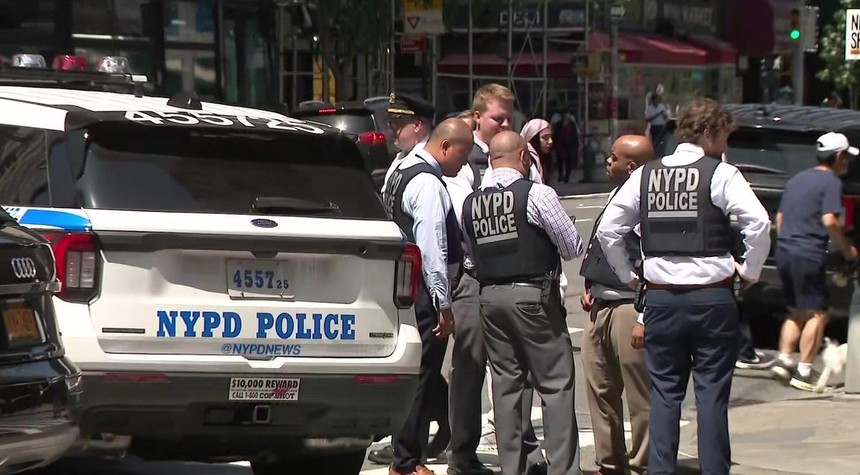
A 51-year-old Manhattan man has been charged with attempted murder as a hate crime following a double stabbing attack on New York City’s Upper West Side Thursday that left two victims from different communities wounded and searching for answers about public safety.
Raul Morales faces attempted murder as a hate crime, assault as a hate crime, and criminal possession of a weapon for the stabbing of Moshe Grunhaus, a 50-year-old Jewish man, according to police authorities. In the separate attack on a 57-year-old Asian man, Morales has been charged with attempted murder, assault, and criminal possession of a weapon, though notably not as a hate crime in that instance. Both victims are expected to survive their injuries.
Police Commissioner Jessica Tisch reported that the suspect allegedly shouted “Allahu Akbar” during both attacks, a detail that has raised significant concerns about the nature and motivation of these violent incidents.
Law enforcement officials executed a search warrant Friday at Morales’ apartment building, located near the scene of the attacks. Investigators removed several items, including a laptop and a collection of books. Among the materials recovered were a Quran and a book about Che Guevara, though authorities have not confirmed whether these items belong to Morales, who shared the apartment with other residents.
Neighbors have described Morales as withdrawn and uncommunicative. One resident told investigators that Morales never responds to greetings, maintaining complete silence even during routine encounters in the building.
The case presents a complex picture of the suspect’s background and possible motivations. While Morales has no documented mental health history with the New York Police Department, Commissioner Tisch indicated that the preliminary investigation suggests mental health issues may have played a role in the attacks. Police records show Morales has a prior criminal history that includes two open drug arrests.
The differential charging in the two attacks has drawn attention from both the Jewish and Asian communities, who have expressed shared concerns about safety in the city. The decision to classify one attack as a hate crime while not applying the same designation to the other has raised questions about the criteria used in such determinations, though prosecutors have not publicly explained the reasoning behind this distinction.
This incident adds to growing concerns about violence targeting minority communities in New York City. Both the Jewish and Asian communities have experienced increased threats and attacks in recent years, prompting calls for enhanced security measures and more aggressive prosecution of bias-motivated crimes.
The investigation remains active as authorities work to establish a complete timeline of events and fully understand the suspect’s motivations. The case underscores the ongoing challenges facing law enforcement in addressing hate-motivated violence while also considering the complex factors, including mental health issues, that may contribute to such attacks.
As this case proceeds through the criminal justice system, it will likely reignite debates about how hate crimes are defined, prosecuted, and prevented in one of America’s largest and most diverse cities.
Related: California Hiker Found Dead in Big Sur Died from Alcohol Withdrawal Complications
