
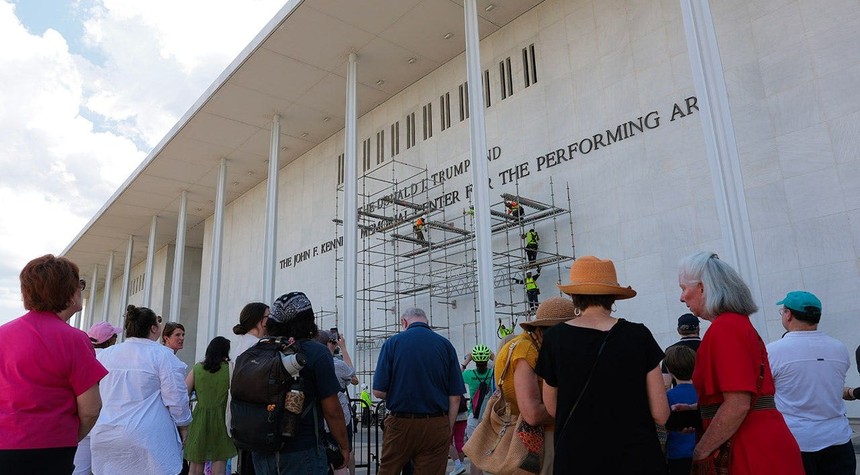
Workers began removing President Donald Trump’s name from the Kennedy Center in Washington, D.C., on Saturday, following a federal appeals court decision that denied a last-minute request to halt the removal.
The removal comes after a lower court judge ordered Trump’s name taken off the building’s facade, overruling a December decision by the Kennedy Center’s board of trustees. That board had voted unanimously to add Trump’s name to the historic performing arts center, changing the official designation to “The Donald J. Trump and John F. Kennedy Memorial Center For The Performing Arts.”
Scaffolding was erected around the Washington landmark on Friday, and workers began the process of removing Trump’s name from the signage on Saturday. The appeals court’s denial of the board’s emergency request effectively cleared the way for the immediate removal to proceed.
The Kennedy Center board had defended its December decision by citing Trump’s role in what it described as saving “the institution from financial ruin and physical destruction.” The board moved swiftly at the time, affixing Trump’s name to the building’s facade the day after the vote.
The legal battle over the naming rights has raised questions about the process by which federal institutions can alter their official designations and the role of the judiciary in reviewing such decisions. The Kennedy Center, while operating as an independent nonprofit organization, occupies federal land and receives federal funding, complicating the legal landscape surrounding the dispute.
The removal of a sitting president’s name from a prominent federal building in the nation’s capital represents an unusual development in American political history. The Kennedy Center has long stood as a living memorial to President John F. Kennedy and serves as the nation’s cultural center, hosting performances and events that draw audiences from across the country and around the world.
The speed with which events have unfolded has been remarkable. From the board’s unanimous vote in December to the affixing of Trump’s name within 24 hours, to the subsequent legal challenge and now the removal, the entire sequence has played out in a matter of weeks.
The appeals court provided no detailed explanation for its denial of the board’s emergency request, leaving the lower court’s ruling in place. Legal observers note that such emergency appeals face a high bar for success, requiring the appealing party to demonstrate both a likelihood of success on the merits and irreparable harm if the stay is not granted.
As workers continued their task on Saturday, the Kennedy Center remained open to the public, with performances scheduled to continue as planned. The institution has not issued a statement regarding how it will proceed following the name removal or whether it will continue to pursue legal remedies.
The matter underscores the complex intersection of politics, law, and cultural institutions in the nation’s capital, where decisions about naming and memorialization often carry significance far beyond their immediate practical implications.
Related: American Soccer Players Display Faith After Historic World Cup Win at SoFi Stadium
