
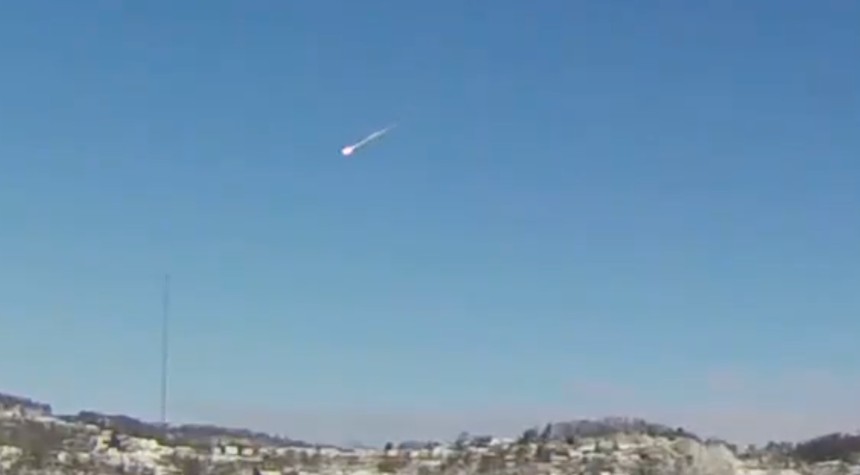
A powerful sonic boom that rattled homes across Cleveland and reverberated as far as New York and Pennsylvania has been identified as a meteor entering Earth’s atmosphere, according to the National Weather Service.
The event, which occurred Tuesday morning, initially sparked concerns among residents who feared an explosion had taken place. Reports from Cleveland residents described a boom forceful enough to shake entire homes, prompting immediate calls to local authorities and weather stations.
The National Weather Service office in Pittsburgh captured video footage of the meteor streaking across the sky, providing visual confirmation of the atmospheric event. The footage shows a bright object arcing through the morning sky, leaving a luminous trail in its wake.
Meteorologists have explained that the distinctive boom heard across the region occurred when the meteor exceeded the speed of sound, creating a sonic shock wave that propagated across hundreds of miles. The precise moment when the object entered Earth’s atmosphere remains unclear, though the widespread nature of the reports suggests a significant atmospheric entry event.
The identification of the meteor was made possible through sophisticated atmospheric monitoring equipment. The National Weather Service utilized a geostationary lightning mapper, an instrument typically deployed to track lightning strikes across large geographic areas. This technology, maintained by the National Oceanic and Atmospheric Administration, detects rapid flashes in the atmosphere by monitoring changes in light intensity.
The versatility of the geostationary lightning mapper extends beyond its primary function. Because meteors produce bright, lightning-like flashes as they burn through the atmosphere, the instrument can effectively identify and track these celestial objects. In this instance, the mapper detected a distinctive green flash over Cleveland, consistent with a meteor entry event.
The green coloration observed in the flash is characteristic of certain meteor compositions. As meteors superheat during atmospheric entry, the minerals within them vaporize and emit light at specific wavelengths, often producing the green hue witnessed in this event.
The American Meteor Society, which maintains a comprehensive database of meteor sightings and atmospheric events, has not yet issued a formal statement regarding this particular occurrence. Additional details about the meteor’s size, composition, and trajectory remain under investigation.
Such atmospheric events, while dramatic, occur with some regularity as Earth passes through debris fields in its orbital path. Most meteors disintegrate completely before reaching the ground, though the sonic phenomena they produce can be startling to those unfamiliar with such occurrences.
The multi-state reach of the sound reports underscores the altitude at which the meteor likely disintegrated and the favorable atmospheric conditions that allowed the sonic boom to propagate across such distances. Weather patterns and atmospheric density play significant roles in how far such sounds can travel and how intensely they are perceived at ground level.
Residents who experienced the event are encouraged to report their observations to meteor tracking organizations, as eyewitness accounts contribute valuable data to our understanding of these atmospheric phenomena.
Related: California State Librarian Faces Questions Over Missing Funds in Dolly Parton Literacy Program
