
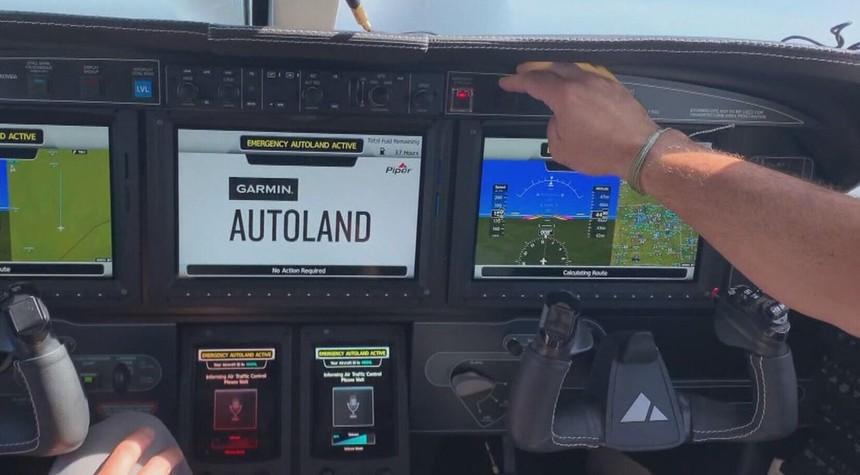
A significant milestone in aviation safety occurred Saturday afternoon when an aircraft landed itself at Rocky Mountain Metropolitan Airport in Broomfield, Colorado, marking the first documented real-world deployment of Garmin’s emergency Autoland system.
The incident unfolded shortly after the aircraft departed from Aspen’s airport when the pilot reported a pressurization problem while flying over the Denver metropolitan area. Air traffic control recordings captured the pilot’s brief communication stating, “We lost pressurization,” before the situation escalated to require emergency intervention.
What happened next represents a breakthrough moment for general aviation safety. A robotic voice transmitted over air traffic control frequencies, announcing, “Pilot incapacitation, two miles south… emergency Autoland in 19 minutes on runway 3-0.” The automated system had taken control of the aircraft, identifying the emergency and executing a landing procedure without human pilot input.
The technology functioned precisely as designed. Garmin’s Autoland system can be activated through a single button press by anyone aboard the aircraft. The system also possesses the capability to self-activate after detecting a prolonged period of pilot inactivity, a critical safeguard given that pilot incapacitation incidents, while rare, prove fatal in nearly all cases.
Flight tracking data from FlightAware confirmed the aircraft, identified by tail number N479BR, completed its landing at Rocky Mountain Metropolitan Airport on Saturday afternoon. Buffalo River Aviation, the charter company operating the flight, confirmed that all individuals involved emerged from the incident safely, though they declined to specify the number of passengers aboard or elaborate on the precise circumstances that led to the emergency.
Local flight instructor Adam Lendi witnessed the landing while conducting a training session with a student. “We saw the fire trucks starting to head out,” Lendi recounted. Having familiarized himself with automated landing systems, he recognized the situation immediately. “I was familiar with the auto land systems, and I recognized that’s what was going on. So I told my student, I said, ‘We might be witnessing something pretty cool here.'”
The successful deployment represents years of technological development coming to fruition at a critical moment. Garmin confirmed the incident in a statement, noting, “Garmin can confirm that an emergency Autoland activation occurred at Rocky Mountain Metropolitan Airport in Broomfield, Colorado. The Autoland took place on Saturday, Dec. 20, resulting in a successful landing. We look forward to sharing additional details at the appropriate time.”
This incident demonstrates how aviation technology continues advancing to address one of general aviation’s most dangerous scenarios. While commercial aviation has long incorporated sophisticated automated systems, bringing such life-saving technology to smaller aircraft represents a meaningful step forward in protecting pilots and passengers alike.
The facts speak clearly. A pilot faced a medical emergency. Technology responded. Lives were saved. That is progress worth noting.
Related: Federal Bureau of Investigation Accelerates AI Integration Under Director Patel’s Leadership
