
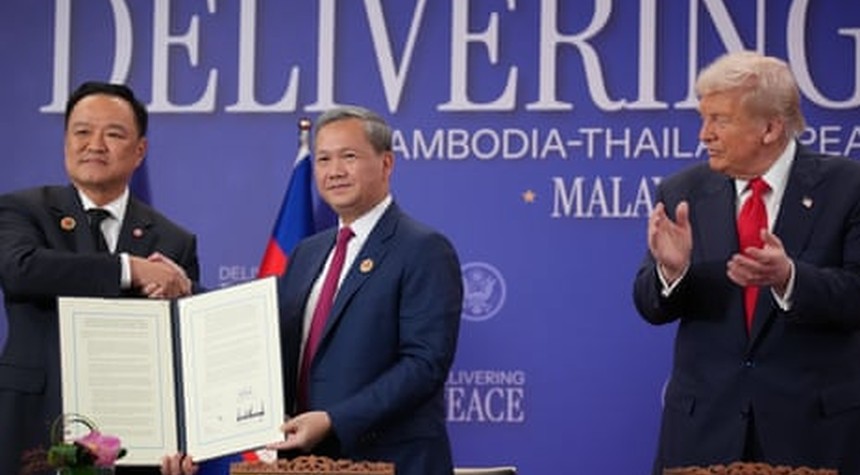
In a clear demonstration of America-first diplomacy, President Donald Trump has successfully mediated a historic ceasefire agreement between Thailand and Cambodia while simultaneously advancing critical U.S. trade interests across Asia.
The landmark peace deal, signed Sunday in Kuala Lumpur, marks a decisive end to the deadliest border conflict in recent Southeast Asian history. Under Trump’s direct influence, Thai Prime Minister Anutin Charnvirakul and Cambodian Prime Minister Hun Manet agreed to remove heavy weapons from disputed territories and cooperate on landmine removal operations. The agreement also secured the release of 18 detained Cambodian soldiers.
President Trump’s intervention proved crucial, as he strategically leveraged America’s economic influence to achieve peace. “The United States will have robust commerce and cooperation, transactions, lots of them, with both nations, as long as they live in peace,” Trump stated firmly, demonstrating how American economic power can be wielded to advance regional stability.
The peace agreement’s impact extends beyond mere conflict resolution. Trump’s diplomatic success has already yielded substantial economic benefits for American interests, including a groundbreaking trade framework with Vietnam limiting tariffs to a maximum of 20%. Additionally, a separate agreement with Malaysia ensures unrestricted U.S. access to critical minerals – a strategic victory given current global supply chain challenges.
In a direct challenge to Chinese economic dominance, Trump secured Malaysia’s acceptance of a 19% tariff on their goods in exchange for mineral access rights. This agreement serves as a template for ongoing negotiations with Thailand and demonstrates Trump’s commitment to rebalancing Asian trade relationships in America’s favor.
The timing of these diplomatic victories is particularly significant as Trump prepares for crucial talks with Chinese President Xi Jinping later this week. With China’s recent ban on rare earth exports threatening global supply chains, Trump’s success in securing alternative mineral access through Malaysia represents a strategic counterweight to Chinese economic leverage.
These achievements validate Trump’s America-first approach to foreign policy, combining peace-making initiatives with hard-nosed trade negotiations. The results speak for themselves: a significant regional conflict resolved, multiple trade deals secured, and American economic interests advanced across Southeast Asia.
Trump’s diplomatic impact has garnered international recognition, with Cambodian Prime Minister Manet nominating him for the Nobel Peace Prize, citing his “extraordinary statesmanship.” Looking ahead, Trump has already set his sights on mediating the Afghanistan-Pakistan conflict, stating his intention to resolve it “very quickly.”
This series of diplomatic and economic victories demonstrates how strong American leadership can simultaneously advance peace while securing concrete benefits for American workers and businesses. It’s a clear example of the Trump doctrine in action: peace through strength, backed by strategic economic leverage.
Related: Monroe Doctrine Finds New Relevance as China Threatens Western Hemisphere
