
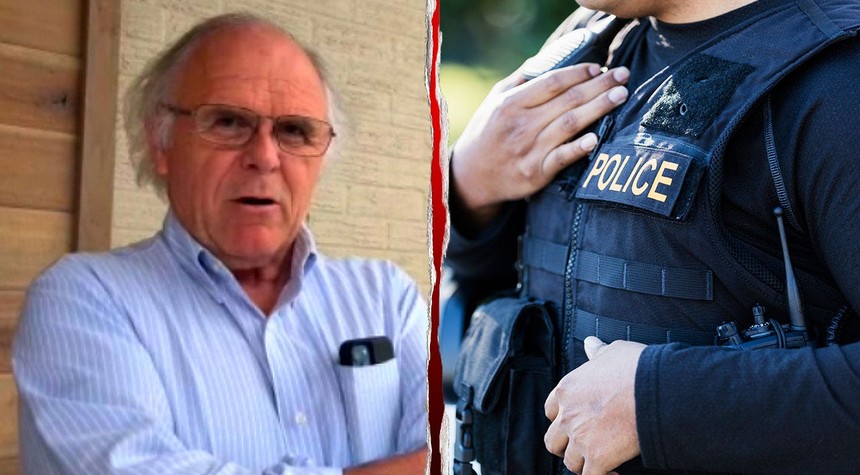
The small town of Cohutta, Georgia, population roughly one thousand, finds itself without a police force tonight after Mayor Ron Shinnick made the extraordinary decision to dissolve the entire department Wednesday morning.
All ten employees of the Cohutta Police Department were terminated, with a handwritten sign posted on the department’s door reading simply, “The PD has been dissolved, and all personnel have been terminated.” It remains unclear whether the officers received advance notice of their dismissal or discovered their termination upon arriving for duty that morning.
The mayor cited what he termed “inappropriate comments” about his wife on social media as justification for the mass firing. However, the circumstances surrounding this decision reveal a more complex dispute that has been developing over recent weeks.
Last month, officers filed formal complaints against Pat Shinnick, the mayor’s wife, who served as the town clerk. According to those complaints, Mrs. Shinnick had allegedly created a “hostile work environment.” She was subsequently removed from her position. The officers’ grievances extended beyond her initial termination, however. They reported that despite being fired, Mrs. Shinnick continued working and maintained access to personal information belonging to the town’s residents.
What makes this situation particularly noteworthy is its timing. The department’s dissolution came just one week after the mayor and officers reportedly engaged in what was described as “open dialogue and good-faith mediation” to resolve their differences. That apparent reconciliation now appears to have been short-lived.
When questioned about the decision and its impact on the terminated employees, Mayor Shinnick offered a brief statement. “They’ll get a paycheck. We’re not that way, and I appreciate their service, okay? It is time for a change,” he said.
The abrupt dismissal of an entire police department raises serious questions about governance, the potential for personal retaliation in municipal decision-making, and most critically, public safety. A community of one thousand residents now finds itself without local law enforcement protection.
In the immediate term, a neighboring town’s police force has agreed to provide coverage for Cohutta while the situation is resolved. How long this arrangement will last, and what permanent solution the town will pursue, remains to be determined.
This incident in Cohutta reflects broader challenges facing small-town law enforcement across America. Departments struggle with recruitment, retention, and the complex dynamics that can arise when personal relationships intersect with professional responsibilities in close-knit communities.
The question now facing Cohutta’s residents is whether their mayor acted within his authority and in the public’s best interest, or whether personal grievances have compromised the safety and well-being of an entire community. That is the way it is.
Related: Missing Hiker Found Dead in Glacier National Park After Apparent Bear Attack
