
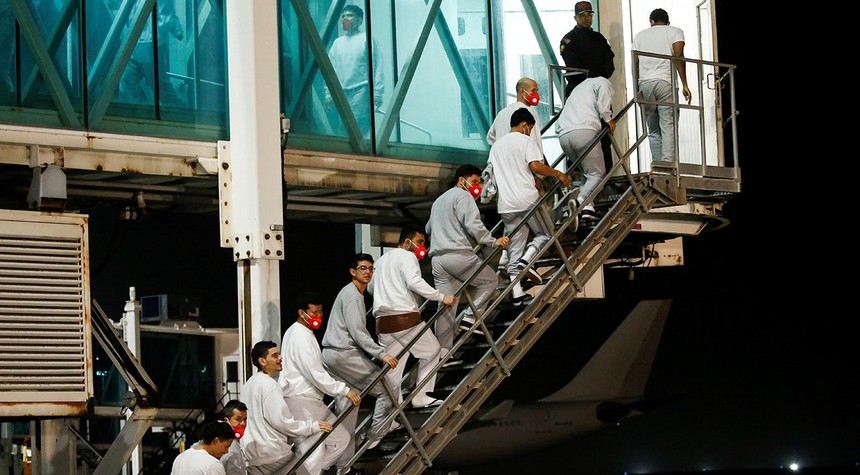
The United States has suspended deportation flights to Venezuela as military operations intensify in the Caribbean, marking a significant shift in Washington’s approach to the Maduro regime and raising questions about the administration’s broader immigration enforcement strategy.
Venezuela’s foreign ministry confirmed this week that the United States has unilaterally halted the twice-weekly charter flights that had been returning Venezuelan nationals under the Plan Vuelta a la Patria, or Return to the Homeland Plan. These flights had repatriated nearly 14,000 Venezuelan nationals in recent months and represented one of the few remaining areas of cooperation between Washington and the government of Nicolás Maduro.
President Trump issued a stern warning Saturday that airspace “above and surrounding” Venezuela should be considered “closed in its entirety” as his administration considers potential military strikes on targets in and around Caracas. The president’s statement came as dozens of American bombers deployed to the region alongside the USS Gerald R. Ford, the world’s largest aircraft carrier, in a substantial show of force.
The military escalation centers on what the administration describes as a fight against narco-terrorism. American forces have already conducted strikes targeting alleged drug traffickers operating in Caribbean waters near Venezuela. Administration officials have indicated that operations could expand to include land-based targets as pressure mounts on Maduro to relinquish power.
The suspension of deportation flights comes at a particularly consequential moment. The Trump administration continues to move forward with plans to end temporary protected status for approximately 600,000 Venezuelans currently residing in the United States. Without functioning deportation flights, the practical mechanics of this policy remain unclear.
Critics have questioned the coherence of pursuing military action while simultaneously disrupting immigration enforcement mechanisms. Curt Mills, executive editor of The American Conservative, characterized the shift as abandoning practical immigration enforcement in favor of military intervention that could ultimately worsen migration pressures.
The deployment of substantial American military assets to the region signals that this administration views the situation in Venezuela as warranting serious consideration of force. The USS Gerald R. Ford’s presence, combined with bomber squadrons now positioned within striking distance of Venezuelan territory, represents the most significant American military buildup near Venezuela in years.
Venezuelan officials have protested what they describe as American aggression, though the Maduro government has limited options for responding to American military pressure. The regime faces mounting economic difficulties and international isolation, factors that presumably informed the earlier cooperation on deportation flights.
The situation presents a complex challenge for American policymakers. Venezuela’s collapse has contributed significantly to migration flows northward, with millions fleeing economic devastation and political repression. Whether military strikes would stabilize or further destabilize the situation remains a matter of considerable debate.
As American forces maintain their positions in the Caribbean, the world waits to see whether President Trump will authorize expanded operations against Venezuelan targets. The decision will have far-reaching implications not only for American relations with Venezuela but for the broader question of how Washington addresses the interconnected challenges of immigration, drug trafficking, and regional instability.
Related: Dell Family Pledges $6.25 Billion to Fund Trump Accounts for 25 Million Children
